Once more, with feeling
Jun.20, 2013, filed under Planet Sam, rambling
 I’m going to a wedding this weekend and I’m super-excited because the person getting married is one of my oldest and dearest friends. Who happens to live in Toulouse. It occurred to me, as things do on occasion, that if I can go to the effort of buying and wearing a dress for Her Majesty the Queen, I can definitely go to the effort of a dress for someone far more important to me.
Thing is, I’m not much of a dressy woman. I work in a job that is either office smart or manky grubby, and when I’m not at work I’m either in sports kit comprising varying degrees of lycra, or slobbing around the house in jeans. Add to this the fact I hate shopping with a passion, and it should be clear that shopping for a dress is something I would only do for a very special occasion. (Next time I might ask people to sponsor me on behalf of the RNLI).
My body, as far as I’m concerned, is primarily for making bikes go faster, getting me around, lifting things, moving through water with speed and efficiency, walking up mountains, taking me to places where I can spoffle sea creatures, and providing the conduit between the contents of my brain and the outside world. What it’s not is a clothes hanger, or an object that exists for other people to admire (or not, as the case may be). Don’t get me wrong — I’m not saying I don’t care what I look like. I do, in as much as I don’t want to look awful. It’s more that I don’t think about it much. I don’t exactly have body confidence so much as when it’s doing what I expect it to do — ride bikes, run, swim, compete in triathlon, walk around, open jam jars, carry bags etc etc etc — then functionality outweighs any physical appearance. When I don my tri suit I may have a moment of relief that I still fit into it after 3 years of being injured out of training, but I don’t worry about what my arse looks like. Not at the time, anyway. I save that for the photos afterwards.
A number of years ago I was very ill, and for a while there was a strong chance I was going to end up in a wheelchair. That was something of a priority check. As long as my body is working, and not threatening to break down again, we’re on pretty good terms. I exercise it, feed it nice food, make sure it gets plenty of fresh air and generally take care of it as best I can.
It has never expressed an interest in fashion.
Shopping is hard. I don’t have a personal style. I don’t know what works for my body shape or type. It’s not on my agenda, most of the time. On the very rare occasion I buy clothes that are not for work or sport, I find something at a price that doesn’t make me faint, in a colour that doesn’t taste horrible, check that it fits and doesn’t look disastrous, and that’s about as much as I can bring myself to care.
Today I needed to buy a dress. I had an hour or so after work, which is my limit for time spent on shopping. I was distracted by the lady in the perfume shop (perfume being the one conventionally feminine thing about which I have strong opinions), where I had gone for a travel pump for my current favoured scent. We chatted. It was fun.
I went to a clothes shop. Everything was in triple figures. I went to another shop, which carried clothes for ladies with curves. Some nice things, but they were expensive and all the colours tasted horrid. I went to another and another, by which point my patience was thin. The fifth shop (fifth!) was quite large, open plan, and had no indication of what all the different sections were. I was a bit lost, and wandered around for a few minutes, hoping for that synaesthetic hit telling me there was at least something in the right colour.
This guy came up to me. He was a little taller than me, thin, and had horrible beard shaved within an inch of its life (I wondered what was the point in having it at all), a posture straight out of the Ministry for Silly Walks, and a staff badge.
“Were you looking for anything in particular?”
“No. I guess I’ll know when I see it.”
“What sort of thing do you want?”
“Long, light, preferably green.”
“A dress?”
“Yes.”
He looked me up and down as if I were a laboratory specimen, or one of those masochistic creatures who subject themselves to the horror of America’s Next Top Model, then gestured vaguely towards the other side of the shop.
“I suggest you try looking over there, dear,” he said, withering. “You’re a bit on the big side for this section.”
I was so shocked I just smiled vaguely and let my feet start meandering in the indicated direction.
I’m not a delicate flower by any stretch of the imagination. I have been described as ‘one solid piece of muscle’. I will never be petite, never be elegant, never be graceful and sinuous. But I can muscle my 70″ fixed up a 12% incline, swim 3km in an hour and open my own damn jam jars. I’m not huge, either. I’m somewhere between a UK size 8 and 12 (US 4-8), depending on brand.
I shouldn’t be bothered by this inconsiderate idiot’s comment. but I was shopping for a dress, to look nice for my friend’s big day, and I felt this man had just told me there was no point in looking at any of the things I liked because I was huge and horrible and far too ungainly to wear beautiful.
This particular shop will never have my custom. Ever. Maybe I was in the petite section. Maybe that was the section for teenagers. I don’t know. I don’t especially care. He could have directed me to a more appropriate part of the shop in a friendly, nice, helpful way. He said it in a way that implied I had no business being there.
And in doing so lost my business permanently.
I spent my money somewhere else, where the shop assistants were helpful, pleasant, and didn’t judge me as if I were a piece of meat and they were looking for something to feed to a fat-shy fashionista.
Big doesn’t mean unhealthy. Thin doesn’t mean fit. Size is so far down on the list of reasons to judge a person I can’t see it with a telescope. I’d rather be fit, healthy, strong and mobile than I would a fashionable size 6 any day.
This was my first ever experience of being judged too big for anything. Should it ever happen again…
Well. It had better not.
Restless
Jun.08, 2013, filed under Planet Sam, rambling
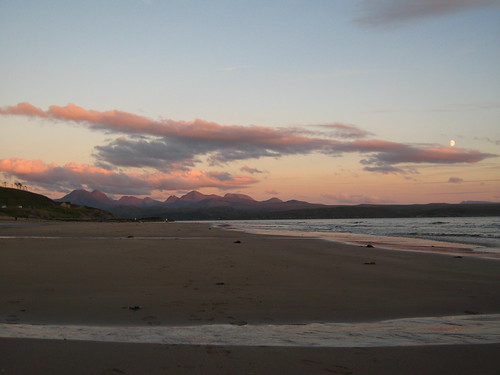
 I love living in Scotland. I missed it terribly while I was down south and experienced a profound sense of relief when I came back. I spent the best part of twenty years in England, and the only way I can think to describe the difference is to imagine what it feels like to be on a crowded train, where you can’t move without bumping into someone. Then imagine what it’s like to be walking on a hillside with only a few other people around and none of them especially close. The difference is one of expansion, but then that might be the synaesthesia talking.
Then again, in Scotland we have places like this:

And this:
So it’s an odd thing for me to experience, as I do today, the sudden urge to pack up and go to another country. I have an itch to revisit Bavaria, or the Austrian Tyrol; to spend some time in Scandinavia or acquaint myself with the Basque country; to explore the hinterlands of Russia or hike the Caucasus. The other tell-tale and oh-so-familiar sign of restlessness is the ready distraction of my collection of recipe books, as RB2 declares dissatisfaction with everything on our current menu list and demands NEW FOOD.
I have no idea what has brought this on. It’s as sudden and unpredictable as a summer squall and, while familiar, not something that has happened in two or three years. In a couple of weeks, I’m visiting Toulouse for the wedding of a dear friend whom I haven’t seen in too long to mention, and perhaps that will satisfy the itchy feet.
Tomorrow there is Knockburn Loch sprint triathlon, and today I’m chained to my desk with deadlines glowering at me over the temporal near horizon. If that doesn’t serve to distract me, it may be time to start planning a roadtrip.
Sam Reviews: Hide Me Among The Graves
May.24, 2013, filed under books, Reviews
 Hide Me Among the Graves by Tim Powers
My rating: 3 of 5 stars
With Powers’s books I’m used to reading stories that make me feel the author knows his protagonists far better than anyone else who has ever written about them. They are mythic, mythical and full of iconography and symbolism. I read Declare and felt that the Cold War had been completely misinterpreted by historians the world over. I knew it hadn’t been, but that wasn’t the point. I felt that it had. I’m used to coming to the end of his books with a view of the world set slightly askew from the one I had when I started.
Sadly, Hide Me Among the Graves didn’t do that for me. Perhaps because there were both too many and not enough similarities to the London of The Anubis Gates, or perhaps because Christina Rosetti (familiar to more in these days of Doctor Who from the lines of “Goblin Fruit” quoted in the episode Midnight) as a character didn’t come through as the passionate, emotional, fey woman who wrote:
Yet come to me in dreams, that I may live
My very life again though cold in death:
Come back to me in dreams, that I may give
Pulse for pulse, breath for breath:
Speak low, lean low,
As long ago, my love, how long ago!
There’s always a danger, when using historical figures, that their depiction the work of fiction is not quite true to the reader’s idea of that person. It’s possible to wave away any differences by pointing out that this is a fictional work, and the universe of the story is not our universe. However, for me Powers’s magic as a storyteller has always been to make me believe, for the period in which I am reading, that it is our universe; and for ever after wonder if there are elements of his universe in this one and I just haven’t noticed.
I didn’t come away from this one feeling our universe might be slightly more magical than for which I’d previously given it credit. There was something missing, some spark that should have melded everything into a cohesive whole. For me it was rather like one of those dishes on Masterchef in which each component is beautifully cooked but the dish doesn’t quite work.
This is an accomplished work, but I’m used to being astonished by Powers, my perspective forever slightly changed. This was a very good story, well-written and entertaining. There is nothing wrong with that. It’s simply testament to Powers’s skill as a writer that previous exposure to his work left me disappointed with this one.
Guest appearance on the Literature Show
May.18, 2013, filed under Writing
 Hot on the heels of Fish coming out in print, this afternoon I will be the guest on the Literature Show on Schmu FM. I’ll be chatting about writing, synaesthesia, and music with Mark Pithie and Ian Anderson.
You can listen in on 99.8MHz if you’re in the Aberdeen area, or on the website from anywhere at all. The show starts at 18:00 BST (6pm, or 17:00 Zulu: here’s a handy converter). The facebook event page is here, and I think you can add any questions or comments there and they may end up in the show.
If you can’t make the live show, you can listen in later from the archive.
I’ve not been on radio before, so this is quite exciting. It should be fun!
FISH in print!
May.05, 2013, filed under fiction, Writing
 I emerge, blinking, bleary and grumpy like a disturbed hamster, from the double insomnia fuel of deadlines and on-call, to announce that Fish is now available from Amazon.
As I’m sure you remember, Fish is the anthology from Dagan Books that contains my dark slipstream story What the Water Gave Her. This was described by SF Signal as:
…a dark, weird and lovely tale about a misunderstood girl, the fish she talks to, and the other things she sees.
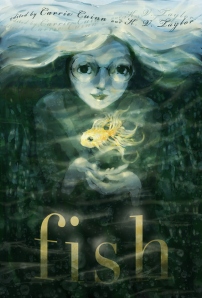
Buying this book will not only get you my story, but will also put works by authors such as Ken Liu and Cat Rambo, Polenth Blake and Corinne Duyvis on your shelf.
Fish is a wonderful mix of new and established voices, offering a range of work from the dark to the whimsical, from science fiction to myth, and in between and none of the above. It has exquisite art by Galen Dara inside and on the cover.
I’ve been waiting to post about it because I, like many of my friends, am very much a lover of the printed form. Now you, too, can experience the thrill of new book smell coupled with the excitement of new work from authors you’ve heard of, and work from authors who may become firm favourites.
“I describe Fish as effortless, dream-like, diverse and exquisite, which certainly holds true as I consider the anthology to be a revelation, because it’s just fish. No restrictions upon genre, no neatly defined prompt to cater to specific tastes. It’s just you and the stories and the fish. Simple and yet so risky. As you read Fish, you step further into a dark and undisturbed ocean where you see reflected light dance across scales and experience ink-black beauty with sharp teeth.†– Haralambi Markov, Alternative Typewriter
Those of you across the Pond can buy Fish from Amazon.com. If you are fully committed to digital, you can still buy your DRM-free ebook directly from Dagan for $4.99. EPUB for NOOK and other readers, here, MOBI for Kindle and other readers, here.
It’s also available from Amazon UK for £3.28 (about the price of a pint, these days), Amazon.com and Barnes and Noble.
Share the love!
Return to Triathlon
Apr.25, 2013, filed under Race reports, Triathlon
 This past weekend saw me return to triathlon competition after a nearly three year hiatus. My last race was Dalkeith, May 2010, and it was in that race I ruptured my plantar fascia—a particularly painful injury that left me hobbling for 9 months.
The turning point came during a camping holiday in Wester Ross, which I spent barefoot. Lo and behold, I was able to walk again. After getting hold of some Vibram Fivefingers, and with a suitable time for recovery, I started running. Swine flu was another set-back, but after two years of re-learning how to run, adjusting my biomechanics the hard way, and careful training, I felt able to return to racing.
Turrif triathlon, a sprint, was my first since Dalkeith 2010. It was great to see some familiar faces as well as getting to know some new ones, and absolutely super to discover my absence had been noticed on the race circuit. I had really missed racing—not just the competition, or the challenge, or even the opportunity to drool over some spectacularly nice bikes, but also the camaraderie. No matter how fast or slow you are, fellow triathletes will cheer you on and congratulate you for your effort. That mutual support is one of the biggest happy-making things I know, right up there with puppies with big feet, Maru with a new box, non-Newtonian fluids and scale invariance.
I wasn’t expecting the race to be a fast one, and it wasn’t. At 1 hour 32 minutes and change, it was the slowest sprint race I’ve completed. The swim came in at around 13’45, but I can’t be sure what the time was because my HRM broke. Transition (and the timing mat) was 150m over uneven ground from the pool and we were required to put shoes on to get down there. The conditions were abysmal, the worst I’ve experienced. Serious wind, rain and hail made the cycle leg even more difficult than the steeply undulating terrain, bad road surface and flooding would have made it anyway. When I entered T2, after my slowest cycle leg ever (50 minutes is appalling) my kit was floating. I am not joking. My toes were so cold that it was a struggle to get them into soggy Spyridons, and my transition time seriously suffered— T2 should not take 1’50.
Despite all that, I managed a PB in the run and a second in class for my first ever placing.
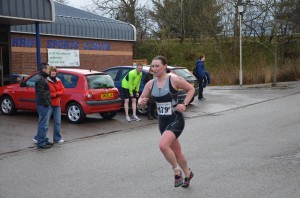
Yay!
My utter delight and sense of achievement is tempered only slightly by my sense of annoyance that the above picture is the only one in which I think I look reasonably good. Here’s another, in which I don’t think I look good:
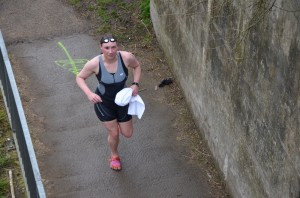
I look at that and think, “Oh gods, I need to lose weight. My thighs look like a pair of canoodling walruses.”
This is so wrong.
In that picture I have just swum 750m in under 14 minutes and was one of the fastest in my heat, having passed everyone else in my lane bar one. I’ve struggled into my bikilas and run across the car park, down some slippery steps, and am on my way to another car park, where I will jump on my bike, ride 20km in absolute filth, then finish off with a 5k run.
Does it really matter that I weigh 67kg and have thighs that touch? What’s more important? That I don’t conform to socially-acceptable standards of beauty (thin, unblemished skin, cheekbones you could shave with, hair as thick as a bear’s), or that I can come back from injury and severe illness and still run faster than I could 7 years ago despite not having shed the relatively small amount of weight I gained during my time off? Should I devote mental energy to bemoaning the fact I can’t even contemplate running without a decent sports bra, unlike some of the more athletic ladies; or spend it considering all the ways I could shave off the paltry 2 minutes that came between me and third lady overall?
Yeah. I don’t need to spend much time thinking about that. In the grand scheme of things, and despite what Dove would have us believe, function is far more important than appearance. I’ll keep on training, and if I should end up leaner and meaner, great, but if I don’t I’m not going to hate myself for it.
My next confirmed race is St Andrews, but I’m looking for others to enter this year. I’ll probably do Inverurie at the end of July, and maybe Knockburn would be fun. Bearing in mind that I like 3-4 weeks between races and don’t want to travel too far this year, any other suggestions?
You don’t need to grow a pair.
Mar.24, 2013, filed under Cycling
 A while back, despite firm resolution not to, I got into an argument on Facebook.
I know.
A fellow cycling enthusiast, one who prefers the Dutch model of segregated facilities (I KNOW) posted about numbers of people cycling. In what I considered to be a counter-productive generalisation, he made an observation that only a small sub-set of risk-taking males choose to cycle on the roads.
Statistically speaking, he might be right, for given values of “statistically speaking”, “sub-set” and “choose”. But it rubbed me up the wrong way, because it’s not a small sub-set of risk-taking males who choose to cycle on the road. I cycle on the road, even when there’s a path available (I find paths inherently more hazardous). I’ve got quite a track record of persuading other women to cycle on the road, too. Frood cycles on the road, and while he’s male (in the strict, biological sense), he’s no risk taker.
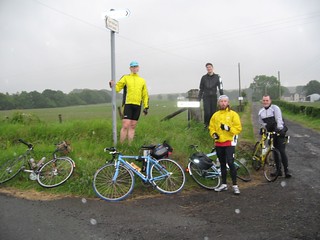
I promise these are not risk-taking males. Plus, that’s my Pompino in the middle of the shot.
In fact, the majority of people I know who cycle on the road don’t do so because they’re risk takers, male or female: they do so because their assessment of the risk is much, much less than that of those who insist it’s too dangerous.
People are not going to be encouraged to cycle by the assertion that the only people willing to cycle on the road are risk-taking males. My experience of encouraging others to start cycling suggests that it’s much more effective to explain risk assessment and mitigation in detail. Ride so people can see you; behave in a way that’s predictable (i.e. like traffic); understand that the vast majority of drivers really don’t want to hit you; and pay attention because not everyone else on the road does, but understand that’s mostly because they’re Clarkson-wannabes or desperate to get home because their children are being menaced by a hungry, angry, peedo lion and the house is on fire, which is pretty rare, and here’s how to deal with them.
Of course, that doesn’t support the argument that cyclists absolutely must have fully segregated facilities before even contemplating putting a leg over a top tube. Still, no argument looks all that great when it’s demonstrably false from the get-go.
Cyclists who choose to cycle on the road are not a small sub-set of risk-taking males, although they may include a small sub-set of risk-taking males. They’re mostly people who have looked at the hazards, availed themselves of relevant mitigation strategies (lights, positioning, behaviour, vigilance, route choice) and decided that it’s a relatively safe activity.
Including me.
Sam reviews: Minister of Chance Episode 4 – The Tiger
Mar.22, 2013, filed under Reviews
 As a MoC supporter, I’ve had my talons on a copy of episode 4 for a while now (by which I mean a couple of weeks) but other projects have kept me from listening.
Sorry, Dan. Hope this makes up for it.
It has been a while since we last visited Tanto, and those of you who have already been swept up by the series might want to go back and listen again to previous episodes. Those of you who haven’t — this isn’t the best place to start. They’re all free, so there’s no excuse for not downloading all of them and catching up. I’ve tried to keep this review spoiler-free, but comments on the story will make more sense if you have some idea of the context. You can also check out my reviews of previous episodes using the MoC tag.

Episode 3 left us in the middle of diverging story arcs and with a number of questions. Episode 4 set about weaving those story arcs back together and answering some of those questions.
It started with a scene of high action, in which a major character (spoilers!) hijacked a vehicle that shall forever in my head be called War Rocket Ajax. We were then given a nice portrayal of Professor Cantha in her new role as Science Advocate for the Resistance — no Ben Goldacre, the Professor; Jenny Agutter did a good job of showing the hesitancy and discomfort of a science hermit pressurised into the role of rationalist preacher. There were shades of Monty Python — when Cantha spoke of a man finding an apple tree, a heckler called, “And he made cider!”
She’s not the Messiah…
We finally discovered the Horseman’s goal, and a little more about him. Maybe a little more is enough, given that the role he performs is somewhere between Judge Dredd and the Predator, measured into a blender with a dose of Time Lord and pulsed until smooth. From his conversations with Kitty, stilted as they were, we are left with the question of whether every Time Lord considers himself and his fellows to be walking weapons of mass destruction, and, again, what was it that brought them here — not to Tanto, specifically, but this particular set of worlds.
There was also the big reveal, of course, although I’ve been bound not to give away any major plot details, so you’ll have to listen to find out that one for yourself.
The immersive quality of the production hasn’t diminished, although I found the mix levels a bit off in places in this particular episode. It was especially noticeable during the first scene with the Minister and the Horseman — the sound effects and music combined to make speech a little hard to hear and you might find it useful to fiddle with the sound settings on whatever device you’re using to give priority to vocals. I also wonder if a brief guide page would be useful, and perhaps one of the Minister Moguls with more time on his or her hands than I have might oblige with a page listing the major characters and locations. Jura and Durian, for instance, look very different on paper, but don’t sound that different. Personal preference, perhaps, but a crib page would help with things like that and also assist with the inevitable fade from memory that happens in the gaps between episodes — not a problem if you listen to them back to back, of course.
The characterisation, as always, is superb. There were some great one-liners and exchanges, particularly where Kitty is involved:
“Give us some food.”
“It don’t grow on trees, you know.”
“Yes it does!”
Then there was the Witch Prime’s (Sylvester McCoy) comment to Durian (Paul McGann):
“Charm only carries you forward. It won’t let you stand still.”
Given Professor Cantha’s apparent faith in the idea of linear cause and effect, the notion that the soon-to-be Witch Prime Emeritus was referring to the quark rather than the personal attribute amused me.
Dan Freeman should be proud of what he’s accomplished with this series. The writing balances satisfying complexity with an awareness of the limitations of the medium. He’s not afraid to expect the listener to pay attention and use his or her grey matter, and it’s a relief to be trusted to work it out for myself. At the same time, he has given us enough information, whether in dialogue or soundscape, to be able to work it out for ourselves, thus avoiding frustration. Hindsight is, after all 20:20. He also devotes effort to character interaction, something of which we don’t get to see (or hear) enough these days. MoC is an oasis in a desert of writing aimed at short attention spans requiring high drama and plot-driven storytelling. Freeman shows it is possible to have excitement and pace without foregoing sophistication.
Episode 5 is in production at the moment and I have high expectations. I’m sure I won’t be disappointed.
Sam reviews: Vibram Fivefingers Lontra
Jan.08, 2013, filed under gear
 Anyone who has spent enough time in my presence to notice my shoes will know that I’m a committed user of Vibram Fivefingers (VFFs), and have been for the last three years. I am rarely found in anything else when travelling on foot. Initially I started wearing them because they allowed me to walk properly and run again after a serious foot injury. Now I wear them because normal shoes feel weird and wrong, not to mention resurrecting the problems that made me turn to barefoot living in the first place. I have KSOs for work and Bikilas for running.
The problem is, of course, that I live in a maritime climate at a similar latitude to Gothenburg, Yekaterinburg and Fort McMurray. That means that most of the year it is wet, and in the winter it is wet and cold. Outdoor pursuits that involve walking or running in VFFs are out for a large chunk of the year. My damaged foot does not tolerate being cold and wet and VFFs are neither warm nor waterproof.
Or rather, they weren’t.
December 2012 saw the long-awaited release of Vibram’s new insulated and/or waterproof models, the Lontra (and its LS variant) and the Speed XC. To say that I’d been champing at the bit to get hold of a pair is something of an understatement. I’d heard about their coming release back in September and my race season generally starts in March. Losing an entire winter’s training could have scuppered my comeback so I went as far as emailing the UK distributors of Vibram, as well as Vibram Europe and Vibram US.
I think I must have been one of the first UK residents to order a pair, direct from Italy just before Christmas. As I’ve got on so well with the Bikila and the KSO I went for the Lontra as the strap fastening and the neoprene cuff appealed. The shoes arrived on Hogmanay, and our trip down to Fife to see my parents was delayed as I refused to go without them.
They had their first outing on New Year’s Day, on a walk that took us across muddy farmland, along the beach, and back up a muddy path.
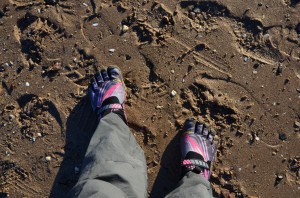
First off, this should not be your first pair of VFFs. If you do not already own a pair, this review is of no use to you. Go and try a pair of Classics or KSOs or Treks first. Then you can come back. The reason I say this is because the laminated, water-resistant fabric is very stiff and the fit is snug. I spent 15 minutes getting these on the first time and if my toes didn’t already know what to do I think I might have failed.
If you already own a pair and the fit is on the tolerable side of small, get a size up from your usual. These are tight. The thicker material and overall stiffer shoe affects how your foot sits inside. I have quite small toes — my big toe is indeed my biggest, my little toe is tiny — and the fit is bearably small rather than comfortable. My other VFFs have a tiny gap at the end of the toes and using socks is not a problem. If you live in a very cold climate and want to wear socks then you may find the recommended size too snug for comfort.
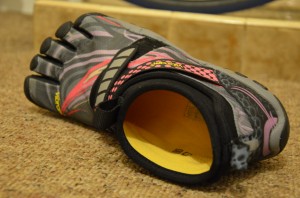
You’ll notice from that image that there is a neoprene cuff and an extra loop at the front. If you try putting these on the way you put on KSOs you’ll be there for a while. The instructions are no different, but I would suggest pulling the neoprene up over the heel far enough that the rear loop is accessible and the heel is up against the main body of the shoe, then working the toes into place with the aid of the front loop, and only then pulling the heel up and settling into the heel cup. These are not shoes to use in an offroad triathlon if you want a fast T2.
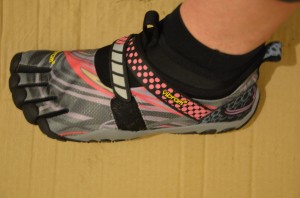
This may also not be the model for you if you have moderate to high arches. I don’t consider myself to have a particularly high instep, but as you can see from the picture the fastening strap only just reaches the fluff for the velcro. It pops off repeatedly, to the point of irritation. I don’t understand why the shoe has been designed like this, as all it would take is another inch or two of strap and it wouldn’t be a problem. It’s not as if they are worried about putting velcro on the strap — there is plenty of it, but the strap itself is too short. Out of curiosity, I decided to see how compressed the shoe got if I attached the strap near the start of the velcro. Below you can see the shoe done up this way and done up without any compression.
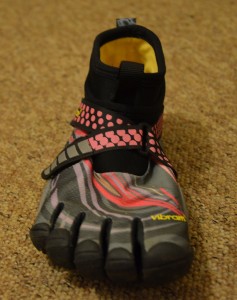
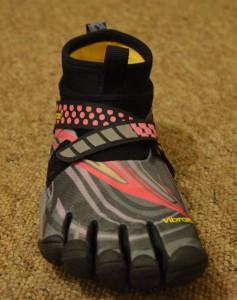
Done up to give a proper foot shape, any flex pops the strap. If I do it up tightly enough for the strap to remain attached, I get painful compression over the top of the foot and my right big toe goes numb. All for the want of an inch or so of strap. It’s mind-boggling.
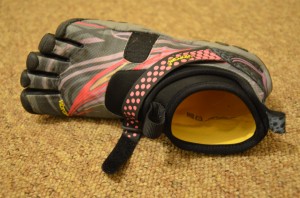
Performance-wise, these more than live up to expectations. They are warm and cosy, and, although billed as water-resistant rather than water-proof, kept my feet dry through mud, shallow rockpools and even a brief foray into the sea to retrieve a ball a toddler had lost. They let in a spot of wet when I used a jet of water from a hose to wash off the mud, and I can’t complain about that.
Some feedback is lost as the footbed is well constructed to protect against rocks and give traction on slippy surfaces. I had no problems walking over pebbles and rocks, and felt sure-footed over mud. The fleecy liner is comfortable against bare skin — I have not worn them often enough to judge what the infamous funk is like.
All in all these shoes do what I hoped they would do in terms of letting me get out and about in the cold and wet. I am mystified by the strap design, and wish I’d known about the tight fit before I bought them. I would probably have gone for the next size up. I would also have given serious consideration to getting the LS variant, which offers more room for high arches, although I suspect I would still have chosen this model because it has the neoprene cuff. In an ideal world Vibram would offer an LS model with elastic laces and a neoprene cuff, or add a couple of inches to the strap on the Lontra.
For summer walking in the wet these will most likely be too warm and the Speed XC might be the better option.
If you feel the same way about ‘normal’ shoes as I do, then Vibram’s new water-resistant range perform brilliantly in terms of keeping out the wet and the cold. Assuming they are all like the Lontras, they are sized ever-so slightly on the small side; and the Lontras have a serious issue when it comes to the strap design. They aren’t cheap, but there’s not much to choose from when it comes to waterproof, insulated, barefoot shoes.
They are definitely a shoe for the enthusiast, and I hope Vibram will improve on the design to make them a more comfortable, forgiving winter option.
Sam reviews: WOTW 2012
Jan.04, 2013, filed under music, Reviews
 No one would have believed, in the last years of the 19th century, that human affairs were being watched from the timeless worlds of space. No one could have dreamed that we were being scrutinized as someone with a microscope studies creatures that swarm and multiply in a drop of water. Few men even considered the possibility of life on other planets. And yet, across the gulf of space, minds immeasurably superior to ours regarded this Earth with envious eyes, and slowly, and surely, they drew their plans against us.
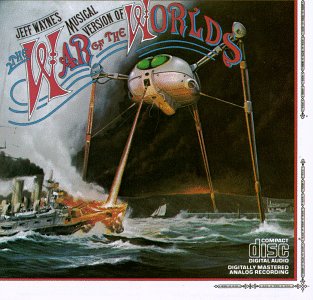
Thus speaks Richard Burton’s inimitable, mellifluous voice at the start of the 1978 Musical War of the Worlds, Jeff Wayne’s most famous creation. My mother has eclectic musical traits (a trait I am endlessly grateful to have either inherited or had inculcated) and a copy of this has been in her music collection for as long as I can remember. It may be a dreadful thing to confess, but this was my introduction to H G Wells and was one of my formative speculative fiction experiences. As a girl of primary school age, my initial reaction was one of awe: never would I consider bacteria the in the same way as I had. My mum has been known to tell family friends that my first comment was, “I’ll never put bleach down the toilet again.”
That’s what good speculative fiction should do. Change the way you think.
The sound effects, chilling in isolation and fed through the score until the guitars became gibbering Martian voices while the synthesisers spat blistering heat rays and spread shivering fronds of red weed across the soundscape, remain as effective now as they ever were. The actors and musicians, used to working live in front of theatre audiences and minus the visual extravaganzas now employed, conveyed their roles with conviction and feeling. The depiction of the Thunderchild crew sacrificing themselves and their ship to save the passenger liner is something I can clearly visualise to this day, despite never having physically seen more than an artist’s impression in the album’s accompanying booklet.
I can see an Ironclad warship going down under the irresistible assault of a Martian heatray, because Jeff Wayne’s composition utterly nails it.
Many years later I picked up an album called Ulludubulla Volume 2, which I reviewed at the time. There I said I didn’t see any reason not to update a musical, but overall the album didn’t really work for me. It was not, however, a remake of the original, but a series of tracks inspired by it.
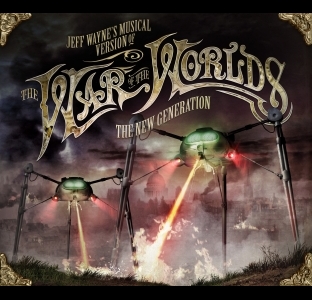
2012 saw a brand new version of this iconic album hit musical theatres and CD/MP3. Richard Burton’s part is now played by Liam Neeson and David Essex’s artilleryman has been given to Ricky Wilson of the Kaiser Chiefs. Justin Hayward’s part is sung by Gary Barlow, who manages to sound like he’s mostly asleep and only doing it for the paycheque. Phil Lynott’s throaty, gargly Parson Nathaniel is now Maverick Sabre with some weird mishmash accent and the beautiful, emotive voice of Julie Covington has been replaced by that of Joss Stone, which is more operatic JCB than concerned but fatally optimistic angel.
The original score has been “updated” with some odd little riffs of electronica and bass, which serve no purpose other than to indicate that this is New! Improved! Hip! and On Trend!
“Hey kids! We know you like dubstep and psytrance these days, so we put in some tweaks just for you!”
Then there’s the script, which has also been altered. There’s an entire additional passage of exposition-heavy dialogue, in which the Journalist explains how the Martians gave up sex and got rid of bacteria. This is, obviously, based on the original work, but part of the joy of the original is that it stands on its own — there is no need to have read the book. When I heard this, I stopped what I was doing and stared at my player. “How in the hell did he find that out? He’s been trudging round a red-weed infested London trying to survive, not conducting scientific research into the mating habits and pathology of the alien invaders!”
I haven’t seen this in the theatre, where they have introduced whizzy special effects. I don’t especially want to now that I’ve heard it. The original didn’t need them, as it was carefully crafted to do without. The 2012 version has suffered from revision and, possibly, part of that is because there are whizzy special effects in the show.
Only one thing stood out as remarkable. Remember I was talking about Ulludubulla Vol. 2? That album starts with an interesting spoken word piece by Papa Ootzie, looking at the Eve of the War from the point of view of the Martians.
“The problem is, of course, the humans,” are the last words spoken in the epilogue, and they sounds suspiciously like a straight lift from the above track.
Unless you are the sort of person who buys things just to have them in the collection, I wouldn’t recommend this version. The original is by far superior in every way, from score to script to performance. Get a copy of that, instead.
-
Singularity
~something that is singular as (a) a separate unit, or (b) unusual or distinctive manner or behavior; PECULIARITY;
~the quality or state of being singular;
~a point at which the derivative of a given function of a complex variable does not exist but every neighborhood of which contains points for which the derivative exists;
~a point or region of infinite mass density at which space and time are infinitely distorted by gravitational forces and which is held to be the final state of matter falling into a black hole. Sight